Data Marks: TL;DR Essentials

There's a lot of focus on the technical details of data science, but many overlook a crucial aspect: presenting the findings.
How should you do it?
The answer is TL;DR, and I'll share my thoughts on it below.
TL;DR is a concise summary for your data science reports.
TL;DRs are helpful for a reader to quickly get the gist of your learnings. An effective TL;DR highlights key points that stakeholders can easily recall.
Conversely, a TL;DR that is overly lengthy risks being overlooked or forgotten. Below are some strategies for composing a compelling TL;DR for your data science report.
1. Start with the TL;DR
Begin by outlining the central idea and supporting evidence. This summary should guide the structure of your entire report. And then go back to refine the TL;DR when you are done with your thinking. If you're having trouble writing a concise TL;DR, it might be because you're still unclear about your main argument. That's fine; write the TL;DR once your ideas are clear. A good TL;DR should be able to stand alone, essentially serving as a mini-version of your report that highlights the most critical points.
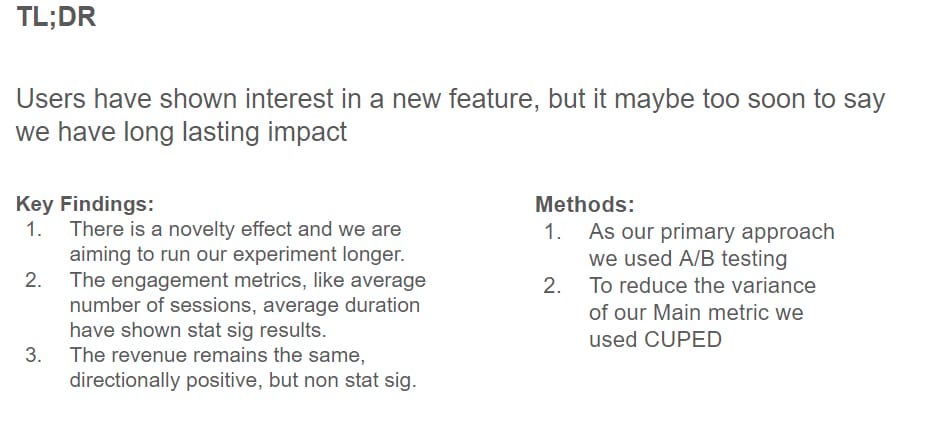
A/B testing TL;DR example.
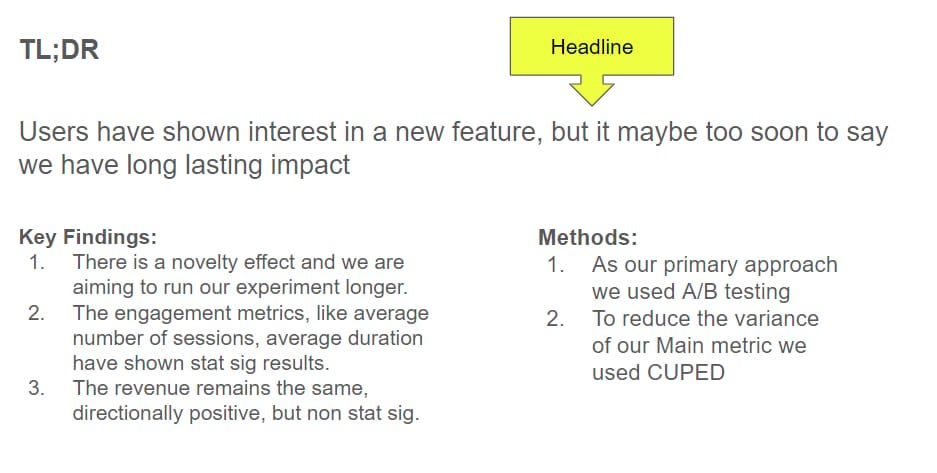
2. Always include a headline
Just Always. This headline is your high level takeaway from your insights’ report. It could be a key learning like, “Users struggle to see the value of the new feature,” or an evaluation like, “Low conversion rates are due to a complex customer flow”. This headline is the main punchline of your work.
3. Limit supporting arguments
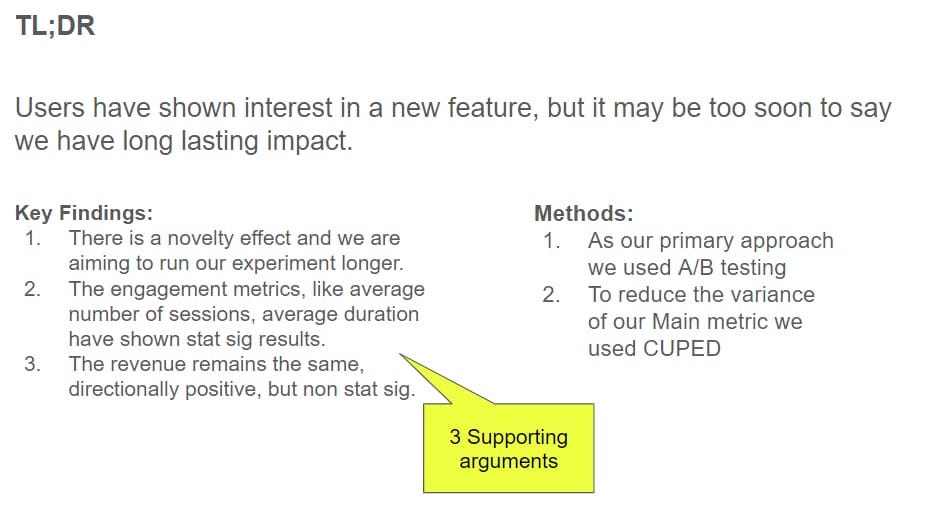
Remember George Miller's concept of the magic number 7 (plus or minus 2)? He posited that humans can keep 5-9 discrete items in their short-term memory. Time has changed and IMHO now people might only retain 3-4 points. Therefore, keep your supporting arguments concise and directly related to your headline, either as additional findings or as reinforcing evidence.
4. Keep it concise
Brevity is key. Eliminate passive constructions and unnecessary details. The TL;DR should avoid delving into methodological specifics, as the target audience, typically stakeholders, may not require such depth. Detailed methodological explanations can be reserved for the main body of the report.
5. Ensure credibility
Your TL;DR should be credible based on known facts, logical reasoning, and your professional reputation. If you're presenting a new insight, provide enough context to make it understandable without extensive elaboration. If the claim is too complex for a brief summary, consider spreading it across multiple reports to build your case progressively.
Tools for Crafting an Impactful TL;DR
KISS (Keep It Short and Sweet): Opt for simplicity to maintain clarity and impact.
Use Templates: Find a structure that consistently works well for you and adhere to it. For instance, use a headline followed by three supporting points and conclude with a call to action.
Seek External Feedback: Have someone review your TL;DR to ensure it's clear and compelling. It will definitely identify areas that may need more clarification or simplification.